
Case Study:
Foundational Training Transformation
Helping employees meet their sales targets
The Challenge
Our client identified the need to overhaul its foundational sales training for a complex product. The existing learning experience, split into numerous mandatory and optional modules, was repetitive and overly lengthy, especially for those new to the industry.
Employees reported low engagement, found content hard to navigate, and struggled to connect theory to real customer interactions.
Facilitators consistently spent time re-explaining basic concepts, which delayed progression to more advanced, value-adding discussions.

Our Approach
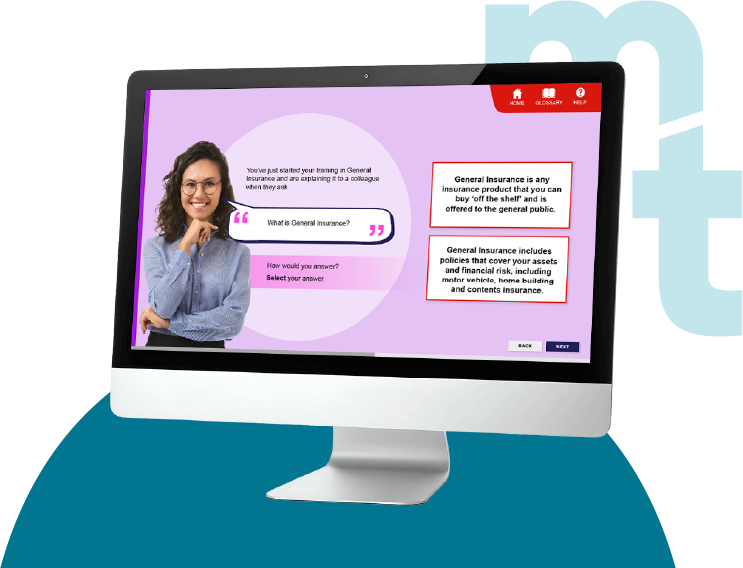
A collaborative approach was adopted, starting with a deep-dive analysis of learner needs and business drivers. The solution included the creation of a streamlined, digital-first foundational program, integrating clear, scenario-based modules and interactive digital resources. Video explainers and animations brought complex concepts to life, while concise eLearning segments allowed learners to progress at their own pace.
To support varied backgrounds, the team developed distinct pathways for new starters and experienced employees, with optional and refresher content layered in.
A smart pre-assessment helped learners identify gaps and skip content they already knew, improving engagement and reducing overall training time.
Practical job aids and quick reference guides were introduced to support on-the-job learning, and ongoing feedback loops ensured the program continued to evolve in line with stakeholder needs and regulatory requirements.
Outcomes
What we delivered was a reimagined learning pathway with over 130 minutes of training, designed to provide a cohesive and engaging learning experience for employees at all levels.
The pathway commenced with optional pre-work, including introductory videos and activities that covered the basics, ensuring that those new to the industry could build foundational knowledge from the ground up. The main content introduced learners to the key value proposition of the product, highlighting the unique benefits this brings to customers.
A series of scenario-based modules, such as an animated Customer Journey, made the learning relevant by showing how employees play a vital role in delivering positive customer outcomes. The pathway also included eLearning segments focused on familiarising employees with available resources, providing reassurance and practical support for new starters.
A smart pre-assessment allowed learners to tailor their journey, skipping content they were already confident in, while a comprehensive eLearning module on the foundations was positioned later in the pathway to consolidate understanding of key concepts and the sales process.

Conclusion
Overall, working together we create a flexible, engaging, and relevant learning pathway that empowered employees to excel in their roles and deliver exceptional customer experiences. By prioritising learner needs, embracing digital innovation, and embedding ongoing feedback, the program stands as an example of how targeted training can drive both business outcomes and individual development.