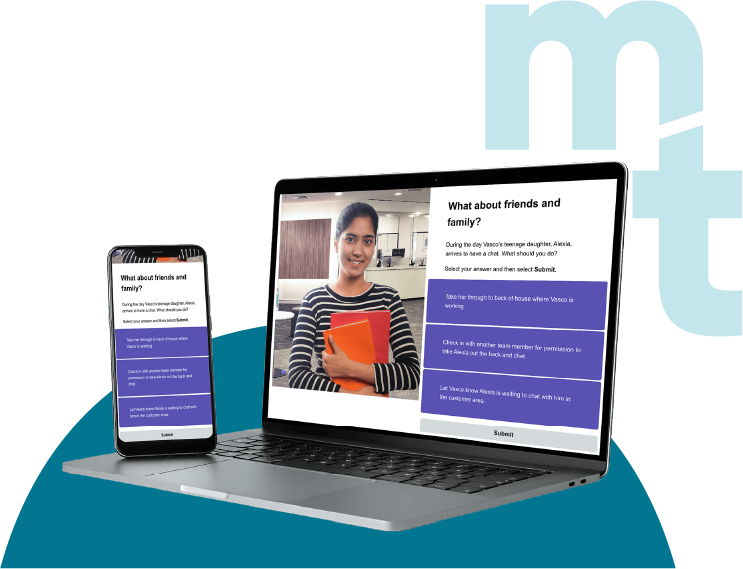
A self-paced program to help keep front line staff safe at work.
The Challenge
Our client faced a significant challenge with its mandatory security training for front-line staff. The existing modules were lengthy, disconnected from real-world operations, and burdensome for staff who were required to complete up to 35 hours of annual compliance learning. The legacy approach focused narrowly on procedures and equipment, resulting in poor retention and increased operational risk during emergencies. Employees found the training time-consuming and struggled to see its relevance to their daily roles, especially in high-pressure situations.
Our Approach
To address these issues, we worked together with our client to redesign the security training modules. The new solution was built on several key principles:
Practical, Scenario-Driven Learning: Modules were reimagined to deliver concise, mobile-optimised content, anchored in real-world scenarios and storytelling. Employees could practise applying security knowledge in branch-specific situations, making the learning directly relevant to their roles.
Tailored Pathways: Content was customised for different audience groups—new starters, seasoned staff, casual visitors, and cash handlers—ensuring each learner received information pertinent to their responsibilities and risk contexts.
Pre-Assessment Innovation: A pre-assessment allowed employees to bypass familiar content, focusing their effort where it was most beneficial. This streamlined approach reduced seat time and improved learner agency.
Accessibility and Inclusion: Custom coding ensured compatibility with screen readers and keyboard-only navigation, setting a new standard for digital learning accessibility for our client.
Performance Support Integration: Checklists and resources were embedded in our client’s secure app, providing just-in-time guidance for critical procedures outside formal training sessions.
Stakeholder Collaboration: The project was shaped by ongoing engagement with leaders, branch staff, and subject matter experts, ensuring the solution aligned with both regulatory requirements and operational realities.
Outcomes
The transformation delivered measurable improvements across efficiency, engagement, and compliance:
Time Savings & Productivity: Within 2 months, 518 employees completed the learning, with the pre-assessment innovation enabling 73.5% to attempt the assessment and 94% to skip content they already knew. This resulted in an estimated annual productivity saving of 28.75 weeks, or $38,237.50.
Positive Learner Feedback: 79% of learners found the training useful, with 39% new starters, 29% using it as a refresher, and 26% learning something new. 87% found the modules engaging.
Enhanced Engagement: Scenario-driven activities and mobile flexibility were cited as significant improvements, making compliance learning more relevant and accessible.
Strategic Impact: The design principles and pre-assessment model were incorporated in our client’s learning playbook, creating a scalable template for future initiatives. Accessibility features are now being rolled out across all mobile-enabled learning.
Continuous Improvement: Regular monitoring of engagement and assessment data, coupled with scheduled content updates every six months, ensures the solution remains responsive to evolving needs.
Conclusion
The security learning transformation has redefined mandatory compliance training—turning it from a transactional obligation into a dynamic, user-centred experience. By focusing on practical relevance, technical innovation, and continuous stakeholder engagement, our client empowered its front-line employees to maintain a secure environment while supporting professional growth and operational excellence.